RESOURCE GUIDE
A free personal finance handbook for students, teachers and parents
State & Nation’s expanded, illustrated 70-page handbook teaches personal finance from the beginning, assuming no prior knowledge. Here is how to use it in class, at home and across your school community.
By State & Nation · Reviewed 2026-10-05
PINNED · TEACHERS RESOURCES
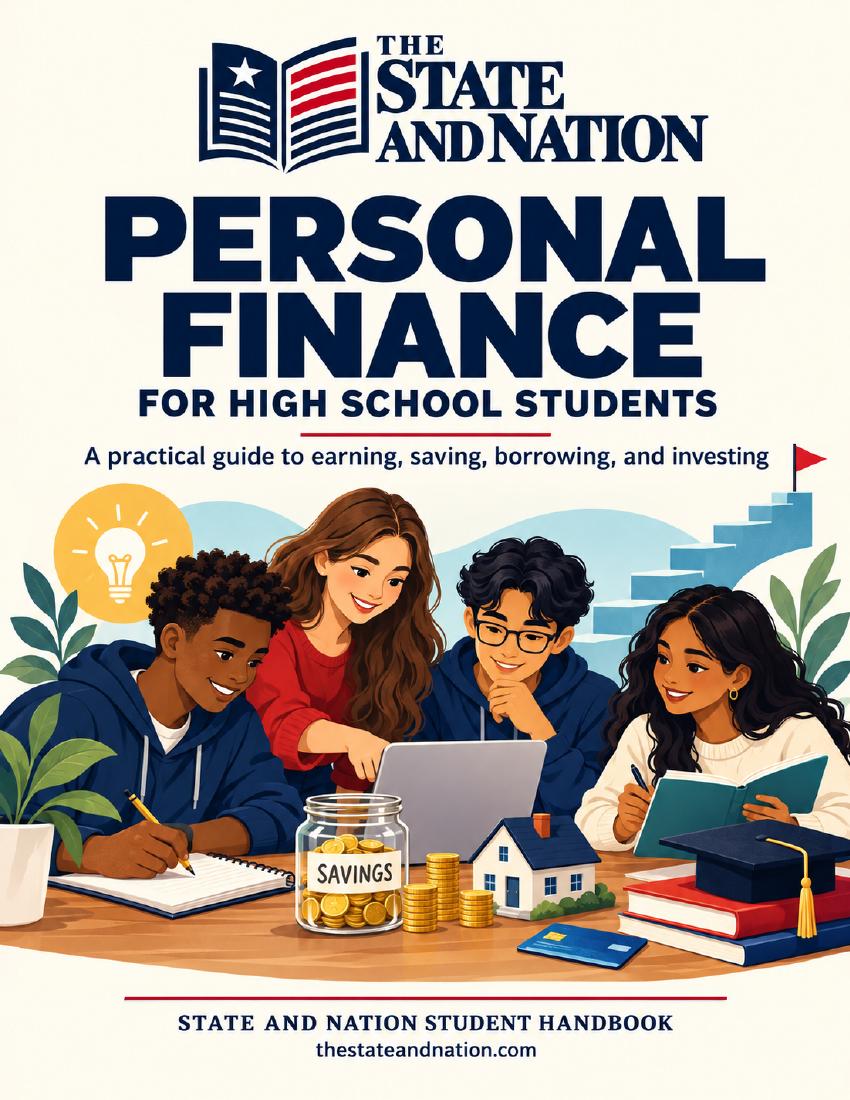
Personal Finance Student Handbook
A free, illustrated 70-page guide for grades 9–12, written for students with no prior finance knowledge. Learn accounts, credit, loans, mortgages and investing through definitions, guided examples and practice.
Expanded beginner edition · Printable PDF · Glossary & practice answers · Rate examples checked October 5, 2026
Money lessons students can use
A first paycheck, a debit card, a college decision or a car loan can turn money from an abstract subject into a daily responsibility. State & Nation’s Personal Finance Student Handbook gives high school students a practical starting point. The free, illustrated PDF is designed for grades 9–12 and can be read on a device or printed as a 70-page handout.
The handbook explains checking, savings and money market accounts; budgets and paychecks; simple and compound interest; responsible credit use; credit reports and scores; car loans and mortgages; financial aid and student loan programs; and saving and investing. Investment lessons cover CDs, bonds, stocks, mutual funds, exchange-traded funds (ETFs) and cryptocurrency. It also distinguishes ETFs from electronic funds transfers (EFTs).
Age-appropriate graphics, worked examples, activities, an action plan and a quiz with answers help students connect vocabulary to decisions. The expanded edition assumes students have no prior knowledge. It defines everyday terms before explaining products, walks through sample bank and credit card statements, separates interest from principal in loan payments, and adds mortgage programs, home equity borrowing, student aid comparisons, practice answers and a glossary. The purpose is understanding costs, asking better questions and comparing choices.
How teachers can share the handbook
Download the complete PDF from the pinned Teachers Resources page. Share that page’s link through your learning management system, a class newsletter or a school resource list, or upload the PDF to your class materials. Teachers may print copies for students and share the complete handbook for educational use. Keep the State & Nation name and source references with the resource.
Use one lesson at a time or organize a five-unit introduction, allowing multiple class sessions as needed: (1) paychecks, budgets and bank accounts; (2) interest and borrowing; (3) credit cards and credit scores; (4) college costs, student aid and mortgages; and (5) investment choices, risk and a personal action plan. Let students use fictional amounts and sample households. No student needs to disclose family income, account balances or debt.
A useful class activity is to compare two account disclosures or two loan offers. Ask students to identify the rate, fees, minimum balance, repayment term and total cost. Have them explain their choice in ordinary language before working through the calculations. Use the handbook’s quiz and answer key to check understanding.
How parents and caregivers can use it
Send the resource page or PDF to your student, read a short section together, or print the pages that match an upcoming decision. A first job is a good moment to discuss take-home pay and a savings goal. College planning is a good moment to compare grants, scholarships, work-study and loans.
Ask questions such as: What fees could this account charge? What happens if you pay only the card’s minimum? How much would this loan cost over its full term? What could make an investment lose value? Keep the conversation focused on choices and habits, and let your student explain what they learned.
Parents can also forward the resource page to a teacher, counselor, parent association or youth program. The PDF does not require a paid subscription or account. Schools and families may share it freely for educational use while retaining publisher attribution.
Understand the rate examples
This edition’s published savings and borrowing rate examples were checked on October 5, 2026; individual sources may have earlier quoted dates, which are identified in the book. Rates and offers can change. Actual borrowing terms depend on the lender, eligibility, credit profile, loan amount and other conditions. Read current disclosures before making a financial decision.
The handbook distinguishes APY on savings from APR on borrowing and labels hypothetical investment returns. An example is a teaching tool, not a guarantee of returns or a recommendation to buy a particular product. The book’s source list points students and adults to official financial education and program information.
A permanent place to find it
The handbook is pinned above the daily updates in Family & Education and has a permanent home in Teachers Resources. Bookmark that page for the PDF and this article. New daily stories do not push the pinned handbook out of view.
Download, print or share the complete State & Nation Personal Finance Student Handbook using the links on this page, then choose one small money habit to practice this week.