
OFFICIAL RELEASE · ORIGINAL ISSUER HEADLINE
TB 26-08 Complex Modes in Lightly Damped Structural Systems: A Two-Mode Interaction Perspective
Issuer publication date: October 13, 2026
Added to The State & Nation: October 13, 2026
What this means
NASA’s Engineering and Safety Center published Technical Bulletin 26-08 on October 13 to explain how nonproportional damping can produce complex modes when two lightly damped structural modes lie close together. Its reduced model, s² = ε²/4 − δ², places the transition at ε = 2δ: weaker coupling mainly brings modal frequencies together, while stronger coupling mainly separates decay rates. NASA recommends evaluating identified poles together with mode-shape phase instead of treating complex modes alone as proof of heavy damping, nonlinearity or poor test data, and links the supporting August 2026 technical memorandum.
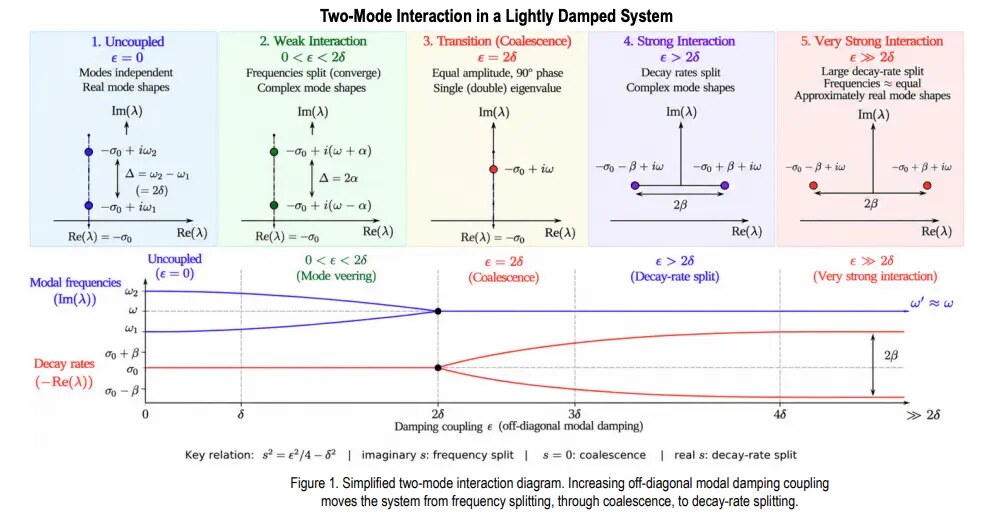
NASA’s two-mode interaction diagram shows frequency splitting, coalescence and decay-rate splitting as off-diagonal modal damping coupling increases.
NASA Engineering and Safety Center
Photo and attribution from the official sourceOfficial release
Source material from NASA. The wording below is the issuer’s statement.
For more information, contact Joel W. Sills, Langley Research Center, joel.w.sills@nasa.gov
Download the PDF version
NASA’s Chemical Equilibrium with Applications (CEA) code is a foundational tool for propulsion system analysis. It provides equilibrium chemistry, rocket performance, shock, and detonation calculations used across NASA and the broader aerospace community. NASA Engineering and Safety Center (NESC) Activity TI-22-01730 modernized the legacy CEA2 Fortran code into CEA v3, a Fortran 2008, object-oriented software package with expanded interface support, updated thermochemical data, improved maintainability, and substantially improved workflow integration. The modernized code preserves backward compatibility with legacy CEA input workflows while enabling direct use from modern analysis environments, including Python, C, MATLAB, and automated design studies.
Why Complex Modes Can Appear at Low Damping
Classical modal analysis often treats lightly damped structures as nearly proportional systems with real mode shapes. That interpretation can become misleading when two modes are closely spaced. In modal coordinates, nonproportional damping introduces an off-diagonal coupling term ε. The relevant question is therefore not simply whether damping is small, but whether the coupling is large relative to the baseline half-frequency separation δ=(ω2 -ω1 )/2.
Reduced Perturbation Framework
For a closely spaced pair, define the central eigenvalue λ0 ≈-ζω +iω and write the coupled eigenvalues as λ1,2=λ0 ±s. Under lightdamping and close-mode asymptotic assumptions, the local quartic eigenvalue problem reduces to s²=ε²/4-δ². This single relation determines the direction of eigenvalue separation in the complex plane, as summarized in Figure. 1. For 0<ε 2δ, s = ±β and the split is predominantly horizontal (decay rate). As ε increases further, β increases and the two decay rates separate more strongly while their frequencies remain approximately equal.
Engineering Interpretation and Recommended Practice
Complexity in an identified mode shape should not automatically be interpreted as evidence of heavy damping, nonlinearity, or poor test data. For a close modal pair, examine the complex poles together with mode-shape phase. Frequency convergence accompanied by near-quadrature modal components is consistent with the imaginary-s regime; nearly equal frequencies accompanied by decay-rate separation is consistent with the real-s regime. The framework also provides a practical testanalysis bridge: s=(λ1 -λ2 )/2 can be obtained from identified poles, while δ can be estimated from the uncoupled or pretest analytical modal spacing. These quantities can then be used to estimate the effective interaction strength and determine proximity to the transition boundary.
References
1. Majed, A., Henkel, E. E., and Sills, J. W., Emergence of Complex Modes in Lightly Damped Structural Systems: A Reduced Perturbation Framework, NASA/TM-20260007553, August 2026.
Release text attributed to NASA. Consult the official publication for any subsequent corrections or updates.
Read the original release
This announcement was published by NASA. The direct link below opens the official publication.
Read the full official publicationhttps://www.nasa.gov/centers-and-facilities/nesc/tb-26-08-complex-modes-in-lightly-damped-structural-systemsa-two-mode-interaction-perspective/
Official statements reflect their issuer’s perspective. The State & Nation is an independent aggregator and is not affiliated with the issuing organization.
Browse the release archiveMore coverage from NASA · Report an error · Editorial standards