Hubble lens images prepare astronomers for Roman’s wider surveys
By Staff Writer · Published 10/22/2026, 2:16:47 PM ET
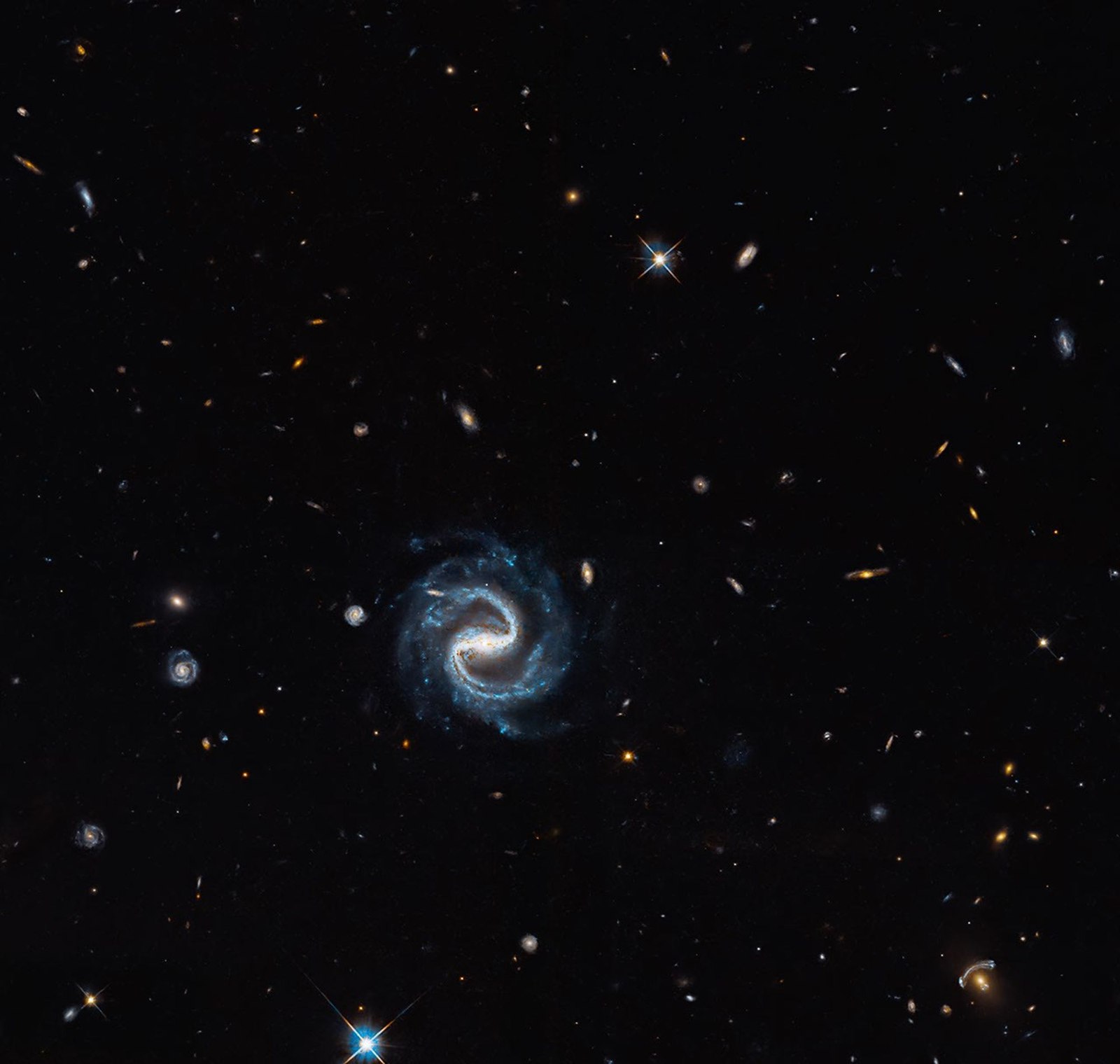
A spiral galaxy shares Hubble’s field with a gravitational lens at lower right, where a more distant galaxy appears as two arcs.
NASA, ESA, and X. Huang (University of San Francisco); Processing: Gladys Kober (NASA/Catholic University of America) · Official image source · NASA editorial-use guidelines permit factual news use without implied endorsement. Full supplied image credit retained; no separate copyright restriction is marked on this release image.Researchers are building an analysis model from Hubble observations to study dark matter in future Roman images.
Astronomers are using Hubble Space Telescope images of distorted galaxies to develop tools for the much wider views expected from the Nancy Grace Roman Space Telescope, NASA reported Oct. 22. The work is intended to help researchers study dark matter by measuring how galaxies bend light.
The agency’s latest example shows two galaxies lined up along the same viewing direction. An elliptical galaxy about 4.5 billion light-years away bends and magnifies light from another galaxy roughly eight billion light-years away. The more distant galaxy appears twice: as a prominent arc and a smaller, inverted arc on the opposite side of the nearer galaxy.
This effect, called gravitational lensing, gives astronomers a way to estimate a galaxy’s mass. NASA explains that visible material alone cannot account for the observed distortion; studying the bending helps researchers estimate the contribution of dark matter, which cannot be seen directly.
Hubble supplies detailed observations of individual lenses. Roman’s broader field of view is expected to capture a larger sample, making the existing Hubble images useful preparation for analyzing those surveys. Researchers are drawing on Hubble observations to build a computer model for interpreting the distortions.
The telescopes also observe different ranges of light. Hubble primarily covers visible and ultraviolet wavelengths, with some infrared capability; Roman primarily covers infrared wavelengths and some visible light. NASA says Hubble will make follow-up observations of particularly interesting lenses found by Roman.
What it means
The immediate development is preparation for a larger survey, rather than a new measurement of how much dark matter the universe contains. Hubble’s detailed examples give researchers a basis for interpreting the more numerous lenses expected in Roman’s wider images. The planned division of work pairs broad searches with closer follow-up; the release does not announce Roman survey results or give a date for those observations.
Source
This State & Nation summary is based on NASA’s original release, dated 2026-10-22. The reporting above is attributed to the official sources linked here.