Webb dust map traces changes before a star exploded
By Staff Writer · Published 11/23/2026, 1:18:18 PM ET
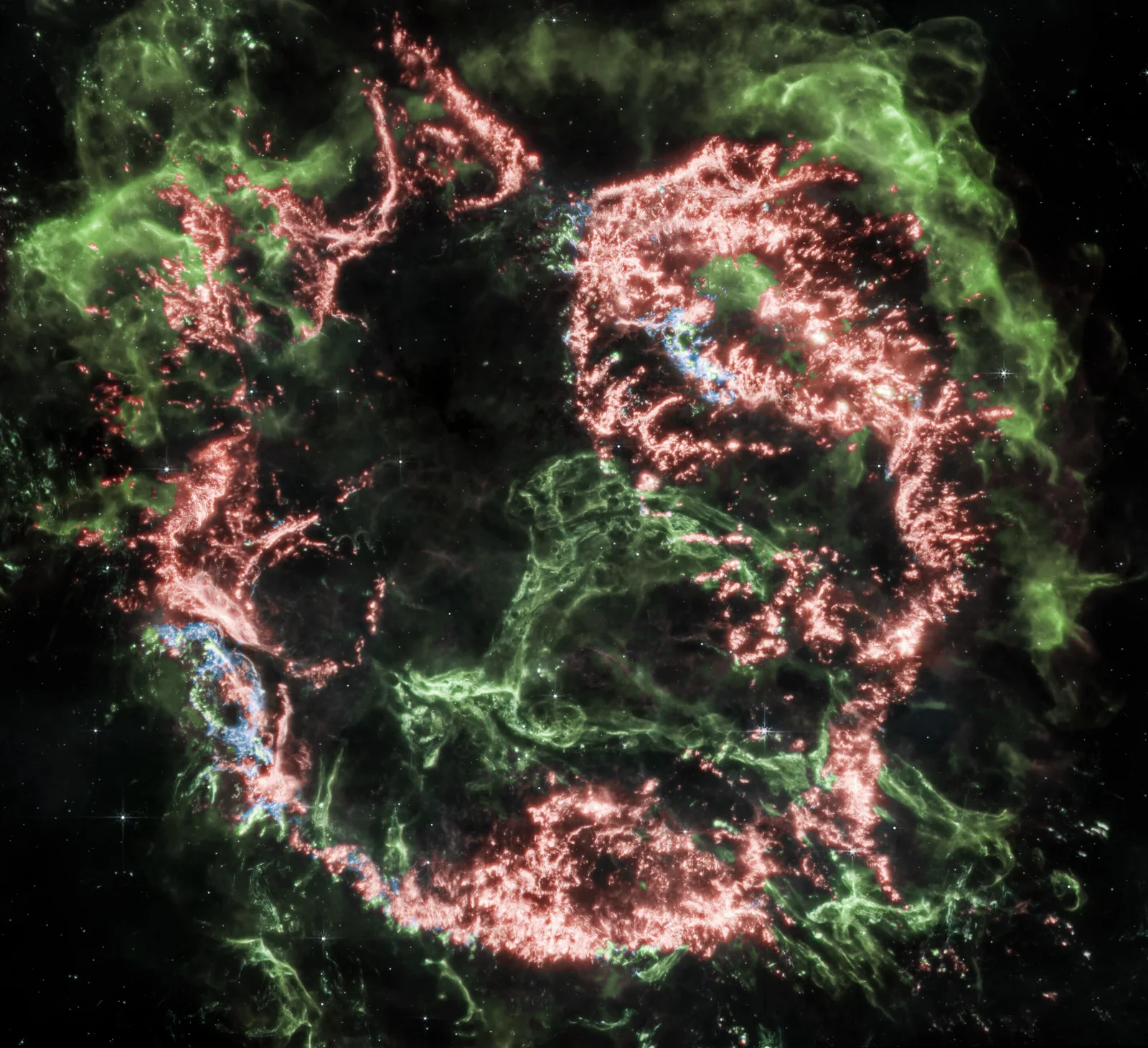
Cassiopeia A in Webb’s mid-infrared observations. The color map separates different dust families, helping researchers study the star that exploded.
NASA, ESA, CSA, T. Temim (Columbia University), R. Arendt (UMBC), D. Milisavljevic (Purdue University). Image Processing: J. DePasquale (STScI). · Official image source · CC BY 4.0 · ESA/Webb reuse termsNASA says Cassiopeia A’s dust contains evidence of mixing inside the original star, possibly in its final hours.
Dust left by an exploded star is helping astronomers reconstruct changes inside it shortly before the explosion, NASA reported November 23. New James Webb Space Telescope observations of the Cassiopeia A supernova remnant support the possibility that internal layers mixed just hours before the star died.
The study, led by Columbia University researcher Tea Temim, was published Monday in The Astrophysical Journal Letters, according to NASA. Its evidence comes from the chemistry of material in the remnant, not a direct observation of the star’s final hours.
Massive stars develop layers where different elements undergo nuclear fusion. Mixing between those layers can alter the material later scattered by an explosion. The researchers used Webb’s detailed mid-infrared observations to examine dust clumps and map their composition across the remnant.
Earlier observations by the retired Spitzer telescope helped identify three areas for closer study. Two lie in debris expelled by the explosion: one contained predominantly silica dust, the other predominantly carbon dust. A third feature, known as the Green Monster, contained complex magnesium silicates and came from material the star had shed before exploding.
NASA says the Webb findings build on X-ray observations from Chandra and the Japanese-led XRISM mission. Signs of the proposed mixing appear across much of the remnant, giving researchers a way to investigate the original star’s structure hundreds of years after its destruction.
What it means
NASA’s November 23 release describes a dust-composition study of Cassiopeia A using Webb, with earlier Spitzer, Chandra and XRISM observations providing context. The researchers report evidence consistent with layers mixing shortly before the supernova and propose using remnant dust to investigate other stars’ histories. The timing remains an inference, including the possibility of changes in the final hours; it is not a directly observed sequence of events inside the star.
Source
This State & Nation summary is based on NASA and ESA/Webb’s original release, dated 2026-11-23. The reporting above is attributed to the official sources linked here.