Martian meteorite preserves water clues from 4.1 billion years ago
By Staff Writer · Published 10/29/2026, 6:13:53 PM ET
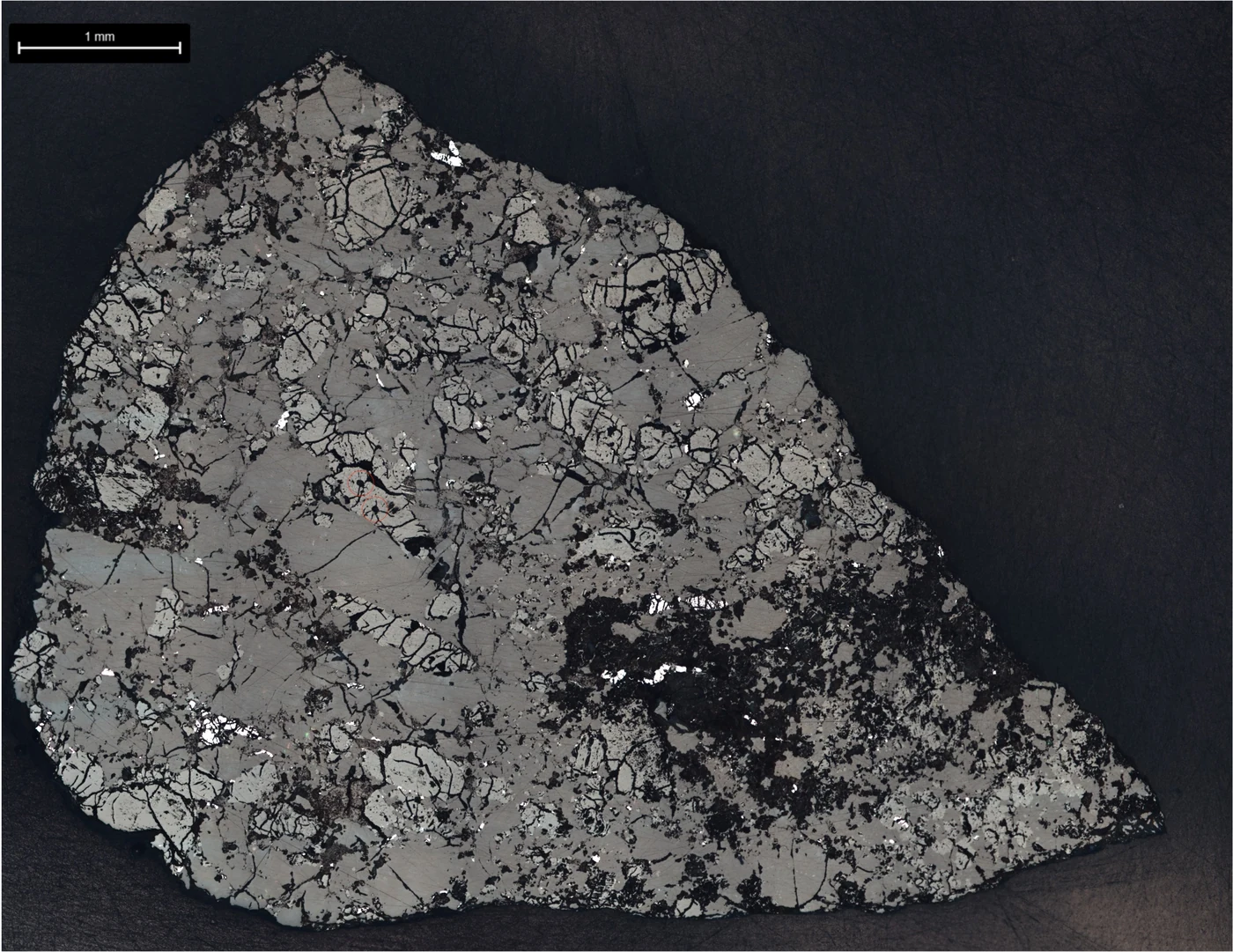
This slice of Teghaza 001, a Martian meteorite, was used to study its mineralogy and chemistry.
NASA/JPL-Caltech · Official image source · NASA editorial image-use guidelinesA NASA-funded team led by JPL scientist Yang Liu has dated water-related changes in Teghaza 001 to about 4.1 billion years ago. The meteorite, found in Mali in 2022, preserves minerals from ancient Martian crust, but its precise origin on Mars remains uncertain.
Researchers studying a meteorite recovered in Mali have dated changes caused by Martian water to roughly 4.1 billion years ago, indicating that the rock formed even earlier. Their initial analysis of Teghaza 001 appeared October 29 in Science, NASA’s Jet Propulsion Laboratory reported.
The 800-gram specimen was discovered in the Sahara Desert in 2022. Researchers at the University of New Mexico identified its Martian origin by comparing its oxygen isotopes with those in other meteorites from Mars. Liu’s team subsequently found an unusual mineral mixture, including zircon crystals that preserve evidence of the rock’s history.
Caltech coauthor Francois Tissot helped analyze individual mineral grains using rubidium-strontium dating. Unlike a bulk analysis that dissolves a sample, the technique examined a small piece while leaving material available for later research. The results place water-driven alteration around 4.1 billion years ago rather than establishing that date as the rock’s original formation.
The mixture of volcanic minerals records crust developing as magma cooled and later changed through contact with underground water. It also resembles minerals observed by the Mars Reconnaissance Orbiter in the planet’s southern highlands. Researchers identified 13 possible source locations, not a confirmed point of origin.
An earlier paper in Science Advances examined the meteorite’s water content in June. The new characterization opens further work on the specimen, including questions about interactions between water and rock on early Mars. Those investigations remain ongoing; this study is an initial assessment, not a complete account of the meteorite’s history.
What it means
Teghaza 001 connects laboratory measurements of ancient Martian material with minerals mapped from orbit. That gives researchers a way to investigate a part of the planet’s crust that other ancient meteorites represent less fully. The unresolved source location limits how precisely they can place this history on Mars, while preserving the sample allows additional studies to test what its minerals reveal about early water.
Source
This State & Nation summary is based on NASA Jet Propulsion Laboratory’s original release, dated 2026-10-29. The reporting and statistics above are attributed to that publication.