NASA revises lunar lander plans for 2028 missions
By Staff Writer · Published 10/23/2026, 11:05:00 PM ET
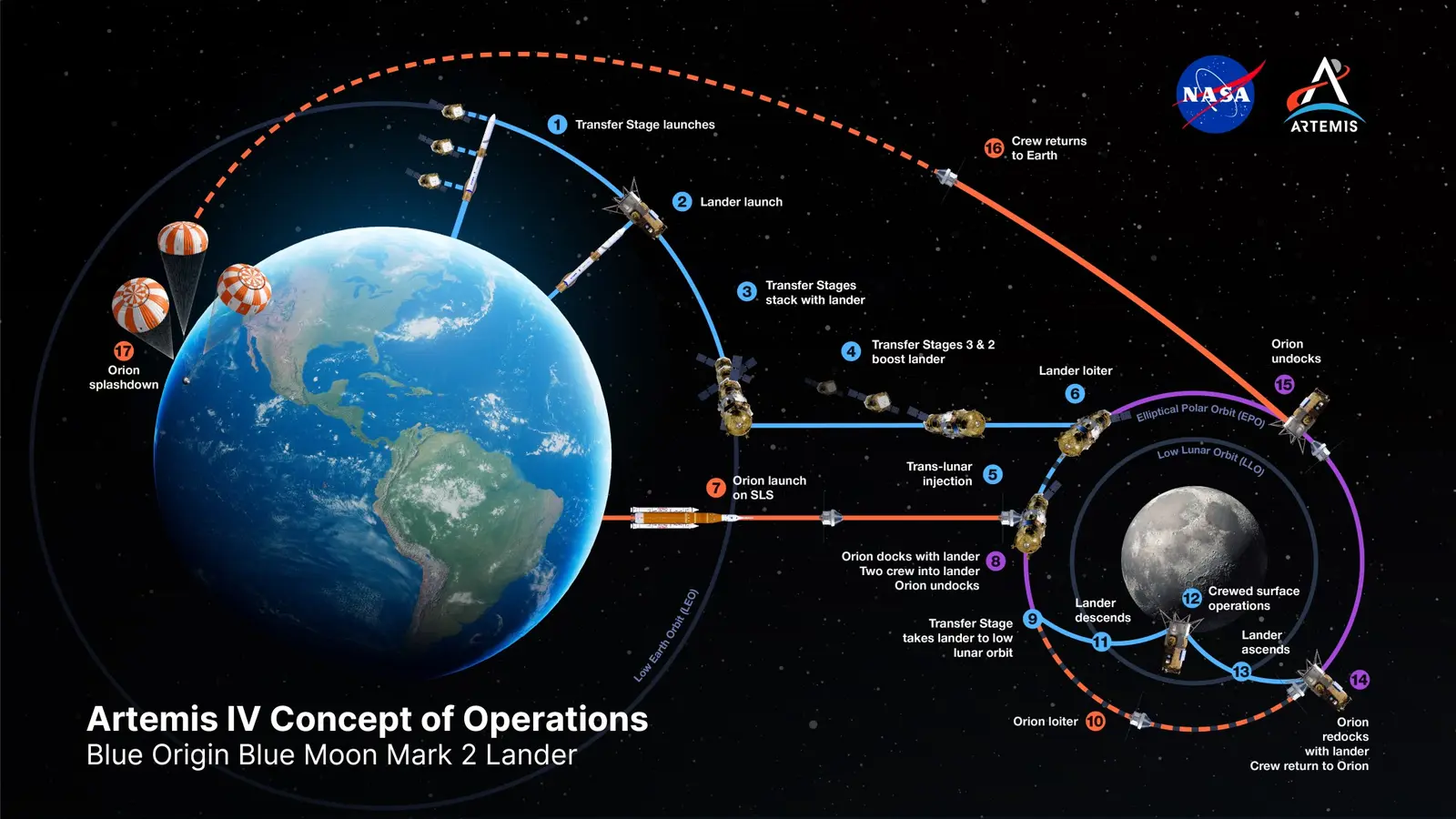
NASA’s concept-of-operations diagram shows Blue Origin’s planned transfer stages and Blue Moon Mark 2 lander traveling from Earth orbit to an elliptical polar lunar orbit.
NASA · Official image source · NASA Images and Media Usage GuidelinesBlue Origin and SpaceX will use different rendezvous and propulsion plans, while NASA will choose the first crewed landing provider based on readiness rather than the companies’ earlier mission assignments.
NASA has revised how Blue Origin and SpaceX landers would carry astronauts from the Orion spacecraft to the Moon, keeping a 2028 target for the first crewed surface mission while removing the companies’ earlier assignments to particular landings. The agency said October 23 that readiness will determine which provider flies the first mission.
Both companies are now expected to participate in an Artemis III demonstration in low Earth orbit, where test versions of their landers would rendezvous and dock with Orion. Before either system carries astronauts to the lunar surface, the provider must complete an uncrewed demonstration and NASA must certify the lander.
SpaceX continues to plan multiple Starship launches to collect cryogenic propellant in low Earth orbit. Under the revised sequence, a fueled Starship lander would meet Orion in Earth orbit, push the joined spacecraft toward low lunar orbit, take two of Orion’s four astronauts to the surface for several days and return them to Orion. NASA says it is working on Orion changes needed for that plan.
Blue Origin plans to defer in-space propellant transfer for its accelerated mission and use three expendable transfer stages to send its Blue Moon Mark 2 lander toward an elliptical polar lunar orbit. NASA says that orbit would reduce the lander’s propellant requirement and shorten the return from the surface to Orion compared with the previously planned near-rectilinear halo orbit.
The contract realignment adds development checkpoints rather than declaring a flight winner. SpaceX is adding two crew-cabin demonstrations, while Blue Origin is adding human-in-the-loop tests and hardware-readiness milestones. NASA says a second crewed landing opportunity will follow the first, but its announcement does not give launch dates for either surface mission or guarantee that the 2028 target will be met.
What it means
NASA announced October 23 that Blue Origin and SpaceX will each demonstrate a revised lunar-lander approach and will no longer be tied to the crewed mission assignments in their original contracts. SpaceX would refuel Starship in Earth orbit and carry Orion toward low lunar orbit; Blue Origin would use three transfer stages and an elliptical polar lunar orbit. Both providers still must complete uncrewed demonstrations and earn NASA certification, and the agency will select the first 2028 crewed landing provider according to readiness.
Source
This State & Nation summary is based on NASA’s original release, dated 2026-10-23. The reporting and statistics above are attributed to that publication.