NASA tests blade design for longer Mars helicopter flights
By Staff Writer · Published 10/20/2026, 10:10:00 PM ET
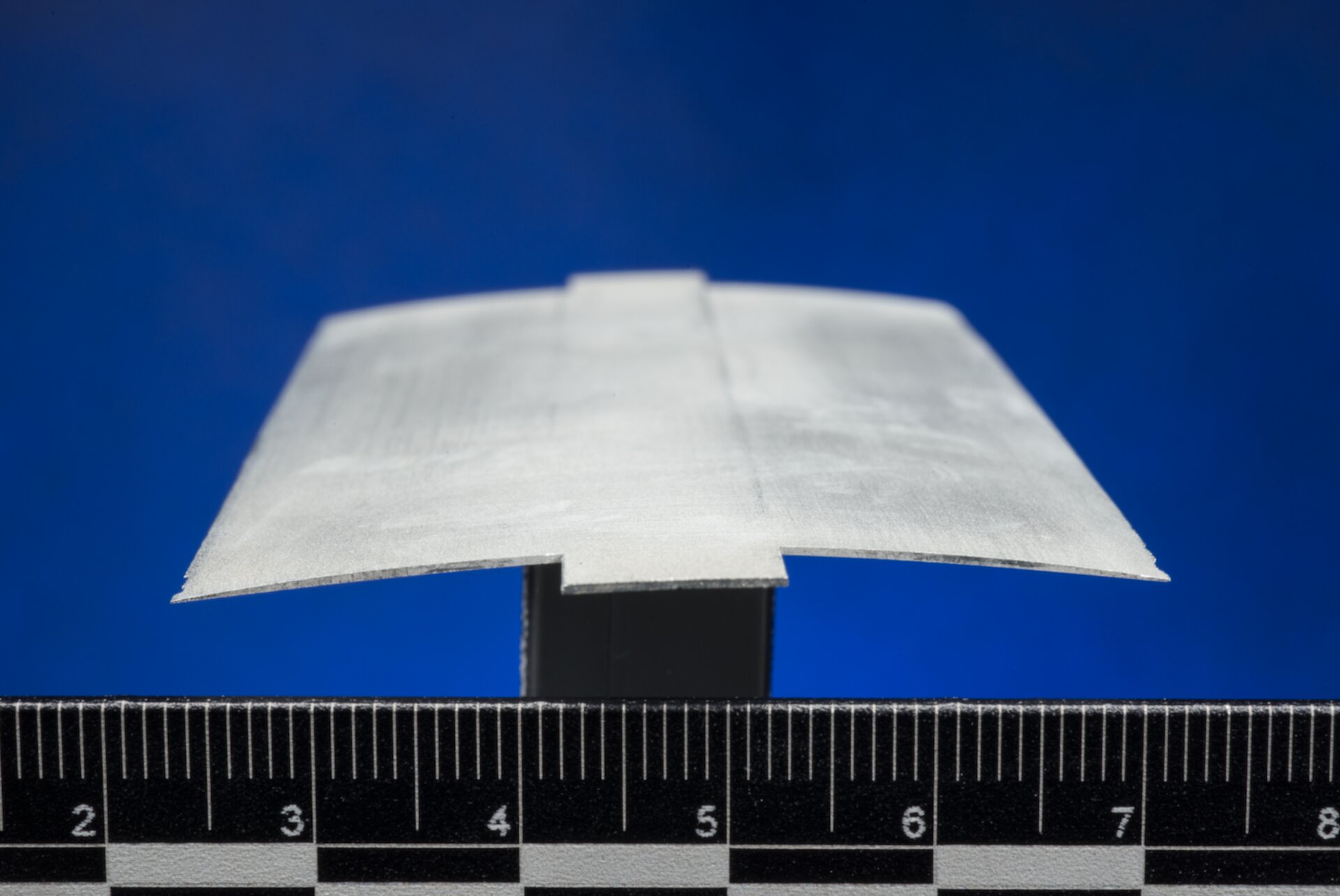
The thin roamx-0201 airfoil tested by NASA researchers is designed for more efficient helicopter flight in Mars’ atmosphere.
NASA · Official image source · NASA media usage guidelinesA thinner experimental rotor profile performed better in simulations and wind-tunnel tests, but NASA says the technology is not ready for a Mars mission.
NASA researchers said October 20 that a thinner experimental rotor-blade design could allow future Mars helicopters to fly much farther while carrying scientific instruments. The work combines computer modeling with wind-tunnel testing and remains a research effort rather than a flight-ready system.
The design, called roamx-0201, was developed by a team at NASA’s Ames Research Center with Imperial College London and Nagoya University. Engineers used simulations tailored to the thin Martian atmosphere to produce an asymmetrical airfoil, then tested the profile in a wind tunnel.
NASA reported that its modeling projected a maximum uninterrupted range of 18.7 kilometers for an instrument-carrying helicopter with the redesigned blades, compared with 0.7 kilometers for Ingenuity. The underlying findings were published September 22 in an American Institute of Aeronautics and Astronautics journal.
The agency said the blade maintained performance longer at high speeds before drag divergence and behaved better in stall conditions than the Ingenuity blade under the conditions studied. Those characteristics could give a future aircraft a wider operating range, although NASA is still working to reconcile differences between its computational predictions and physical tests.
The research is aimed at missions after SkyFall, a planned trio of Mars helicopters scheduled for a 2028 launch. NASA did not announce a mission assignment, development contract or flight date for the roamx-0201 design, and it explicitly said the technology is not yet ready for Mars.
What it means
The tests identify a possible way to extend the reach of aerial science on Mars, where one aircraft could survey more terrain between landings and carry instruments. The 18.7-kilometer figure is a modeled capability, not a demonstrated Mars flight or a committed mission requirement.
The next meaningful evidence will come from further testing that shows the design’s predicted gains hold up consistently outside simulation. Until NASA assigns the blade to a mission and completes development and qualification work, its operational value remains prospective.
Source
This State & Nation summary is based on NASA’s original release, dated 2026-10-20. The reporting and statistics above are attributed to that publication.