Artemis III will test two landers in Earth orbit
By Staff Writer · Published 10/24/2026, 12:14:30 AM ET
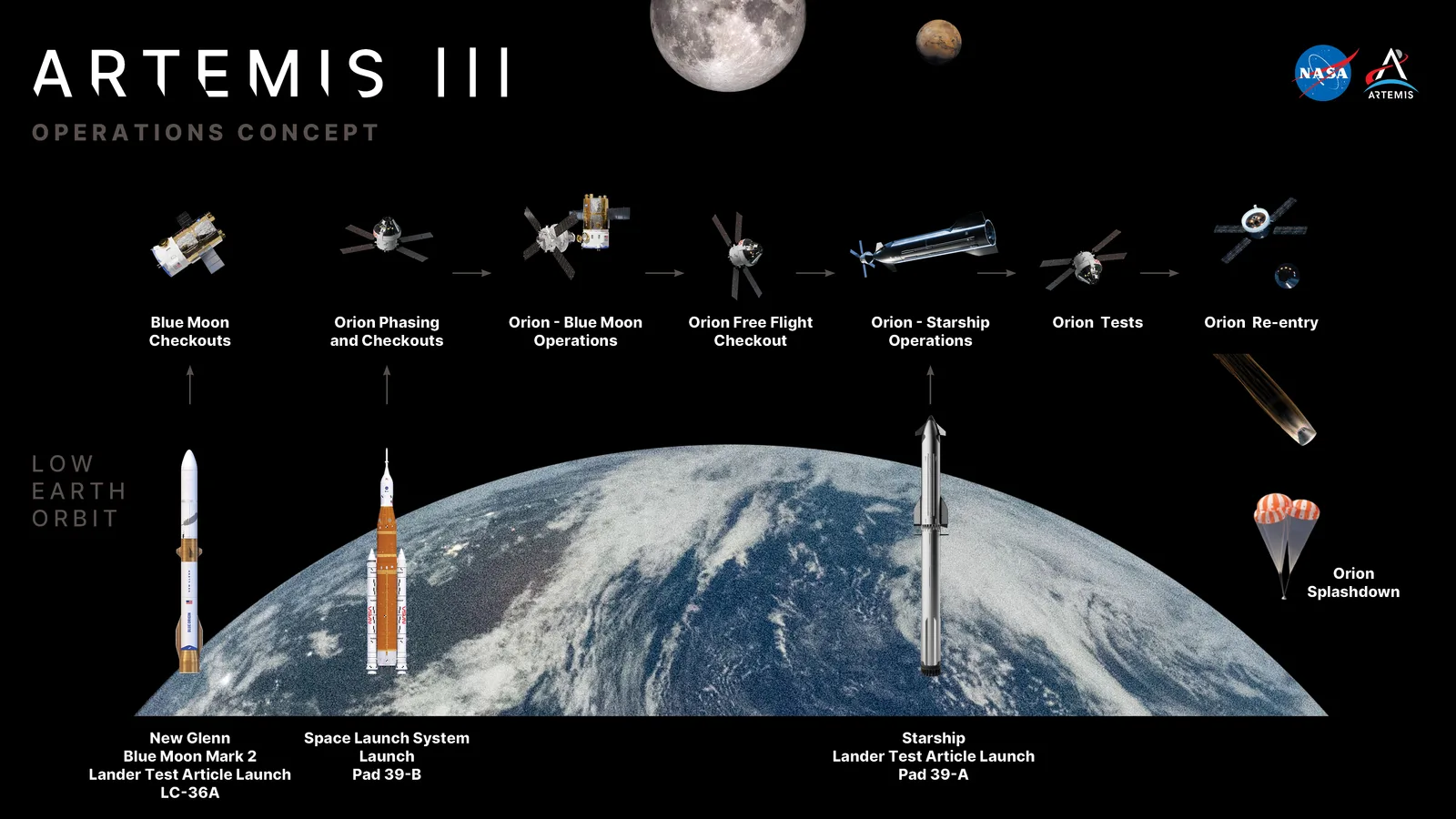
NASA’s Artemis III concept-of-operations graphic outlines separate low-Earth-orbit docking tests with Blue Origin and SpaceX vehicles.
NASA · Official image source · NASA Images and Media Usage GuidelinesNASA plans a 14-day crewed mission in 2027 that will dock Orion with Blue Origin and SpaceX test vehicles before surface missions begin in 2028.
NASA plans to use Artemis III as a 14-day crewed integration test in low Earth orbit in 2027, putting Orion through separate docking demonstrations with lander test vehicles from Blue Origin and SpaceX. The four-person crew will be NASA astronauts Randy Bresnik, Frank Rubio and Andre Douglas and European Space Agency astronaut Luca Parmitano.
The plan requires three spacecraft to launch on three rockets in a coordinated sequence. Blue Origin would send a Blue Moon Mark 2 test article into an orbit about 273 miles above Earth, where it could wait as long as 30 days. NASA would launch Orion on the Space Launch System days later, after confirming the Blue Moon vehicle is ready for joint operations.
Orion would maneuver into a circular orbit near 345 miles and dock with Blue Moon. The astronauts would enter the lander for about two days to evaluate its cabin, controls, life-support functions and ability to maintain atmosphere and pressure. NASA says the flight would be the first crewed evaluation of a commercial lunar lander and Orion operating together.
After Orion leaves Blue Moon, SpaceX would launch a Starship Version 3 test article into a lower orbit. Orion would dock with it for a test lasting up to two hours, but the crew would not enter Starship. NASA and SpaceX intend to evaluate control, communications, software and the dynamics of docking and undocking.
The crew could spend as many as five additional days on Orion tests, health and biology investigations, Earth and solar observations and preparations for future lunar-sample handling. NASA plans a Pacific splashdown off California after the orbital work is complete. The October 23 plan does not provide launch dates for the three rockets or guarantee that the 2027 mission and 2028 surface target will hold.
Update, November 4: NASA’s latest overview keeps Artemis III’s 2027 test-flight target and Artemis IV’s 2028 landing target. It also says Artemis IV planners are retaining two SLS upper-stage options—the existing interim cryogenic propulsion stage and a longer ULA Centaur V design—rather than committing the landing mission to one configuration.
NASA says Axiom Space is developing a lighter Sortie suit for the first lunar-surface outings, alongside the primary suit intended for more demanding missions. The agency puts the smaller suit at roughly half the weight of the primary design; that is a development description, not evidence that a suit has completed flight qualification.
NASA also reports that Artemis III hardware processing timelines have been reduced by about half. Its November 4 account describes an internally built fuel-line component developed and tested in five months for about one-tenth of an earlier outside-vendor estimate. The comparison is the agency’s account of one component, not a verified program-wide cost saving.
What it means
NASA’s November 4 overview keeps a 2027 Earth-orbit test and a 2028 lunar landing as Artemis targets. Four astronauts would fly a planned 14-day Artemis III mission, docking Orion first with a Blue Origin test vehicle and then with a SpaceX test vehicle. For Artemis IV, NASA is pursuing two SLS upper-stage options and working with Axiom Space on a lighter suit for early moonwalks. The agency also reports shorter Artemis III hardware-processing timelines and a fuel-line component built and tested in five months at about one-tenth of an earlier vendor estimate. These are agency plans and reported development results, not completed flights or guaranteed launch dates.
Source
This State & Nation summary is based on NASA’s original release, dated 2026-10-23. The reporting and statistics above are attributed to that publication.