REAL ID and TSA carry-ons: what changed, what still applies in 2026
By Staff Writer · Published 10/16/2026, 9:49:12 PM ET
REAL ID enforcement and a $45 identity-check option have changed airport preparation. Here is what to know about IDs, shoes, liquids, electronics and battery packing.
Official guidance: USAGov: REAL ID and accepted alternatives · TSA ConfirmID: official payment form and conditions
Data as of 10/16/2026, 9:44:00 PM ET · Updated 10/16/2026, 9:49:12 PM ET
Check your ID before you pack
Airport preparation in 2026 starts with two separate checks: whether you have an accepted identity document and whether your bag meets screening and safety rules. A passport can solve the first problem, but it does not change what you may carry through a checkpoint.
The main recent shifts are REAL ID enforcement, the introduction of TSA ConfirmID for adults without acceptable identification, and the end of routine shoe removal announced in July 2025. The ordinary carry-on liquids limit still applies. Battery restrictions also remain important when a cabin bag is moved into the aircraft hold.
This guide reflects official government and airport information checked October 16, 2026. The Transportation Security Administration handles checkpoint security; the Federal Aviation Administration sets dangerous-goods safety rules, and airlines set their own baggage allowances.
The dates that matter
May 7, 2025: TSA began enforcing REAL ID requirements for state-issued licenses and identification cards used for domestic airport screening. Other accepted documents, including a U.S. passport, remain alternatives.
July 8, 2025: the Department of Homeland Security announced that passengers could keep their shoes on at TSA checkpoints. Follow the officer’s instructions if additional screening calls for removing them.
February 1, 2026: TSA introduced the $45 ConfirmID option for travelers 18 and older who arrive without an acceptable ID. That is an alternative identity-verification process, rather than a charge imposed on everyone without a REAL ID-branded license.
You can fly with a passport instead of a REAL ID license
A REAL ID-compliant state license or identification card is one accepted option. A U.S. passport, U.S. passport card, state-issued enhanced driver’s license, and other documents on TSA’s accepted-ID list can also work for domestic screening. Check the actual document category: a temporary driver’s license is not an accepted substitute.
USAGov advises checking your state licensing agency’s requirements before applying for REAL ID. The process commonly requires identity, Social Security and residency evidence, but the state decides the documentation and procedure.
TSA generally does not require identification from children under 18 traveling domestically. Its current Pay.gov instructions specify an exception: a child flying alone needs acceptable ID to receive TSA PreCheck screening. Airlines can also have separate requirements for unaccompanied children. REAL ID is not a replacement for the passport and entry documents needed for an international journey.
No acceptable ID? Understand the $45 option
The current TSA form on Pay.gov says ConfirmID lets TSA attempt to establish a traveler’s identity when an acceptable document is unavailable. Verification is not guaranteed. Paying does not ensure passage through security or boarding, and additional processing can delay the trip.
Each traveler 18 or older without acceptable ID must complete the process separately. The payment covers 10 days starting with the Travel Start Date entered on the form. A return flight outside that window requires another payment if the traveler still lacks acceptable ID.
Use the official Pay.gov form, check the traveler’s legal name, start date and email carefully, and keep the receipt available electronically or on paper for each checkpoint visit during that window. Paying ahead is recommended; buying the service does not issue a REAL ID or a passport.
Liquids: the familiar small-container rule remains
For ordinary toiletries and other liquids, gels, aerosols, creams and pastes, pack containers holding no more than 3.4 ounces or 100 milliliters each. They must fit in a single clear, quart-sized, resealable bag per traveler. The Port of Seattle’s current TSA guidance continues to give that limit.
Container size matters. A large bottle with a little shampoo left inside is still a large container. Pack ordinary oversized liquids in checked baggage when permitted, rather than assuming the amount remaining will make them acceptable at security.
Exceptions exist for medication and nourishment for infants and children. Tell the officer about items needing an exception and use TSA’s specific medical and child-travel guidance before packing; an exception is not permission to bypass screening.
Do not assume a rule announced overseas applies in the United States. Heathrow’s January 23, 2026 release says its new scanners allow liquids and electronics to remain in hand luggage. That operator announcement does not change TSA’s U.S. liquids limit or the rules at another airport on the same itinerary.
Shoes, electronics and expedited lanes
The shoes-on announcement does not eliminate screening of you or your belongings. Keep your bag organized, make electronics easy to reach, and follow the instructions for the lane you actually enter.
TSA PreCheck remains an expedited-screening program. Reagan National’s airport authority explains that eligible passengers can generally keep laptops and compliant liquids in their carry-on bags in that screening process. Do not assume the same unpacking instructions apply in every lane, and do not confuse keeping a liquids bag inside your luggage with permission to carry larger containers.
PreCheck also does not replace an accepted ID. The Port of Seattle’s identification guidance explicitly includes PreCheck passengers in the REAL ID requirements.
Power banks belong in the cabin—even if your bag is gate-checked
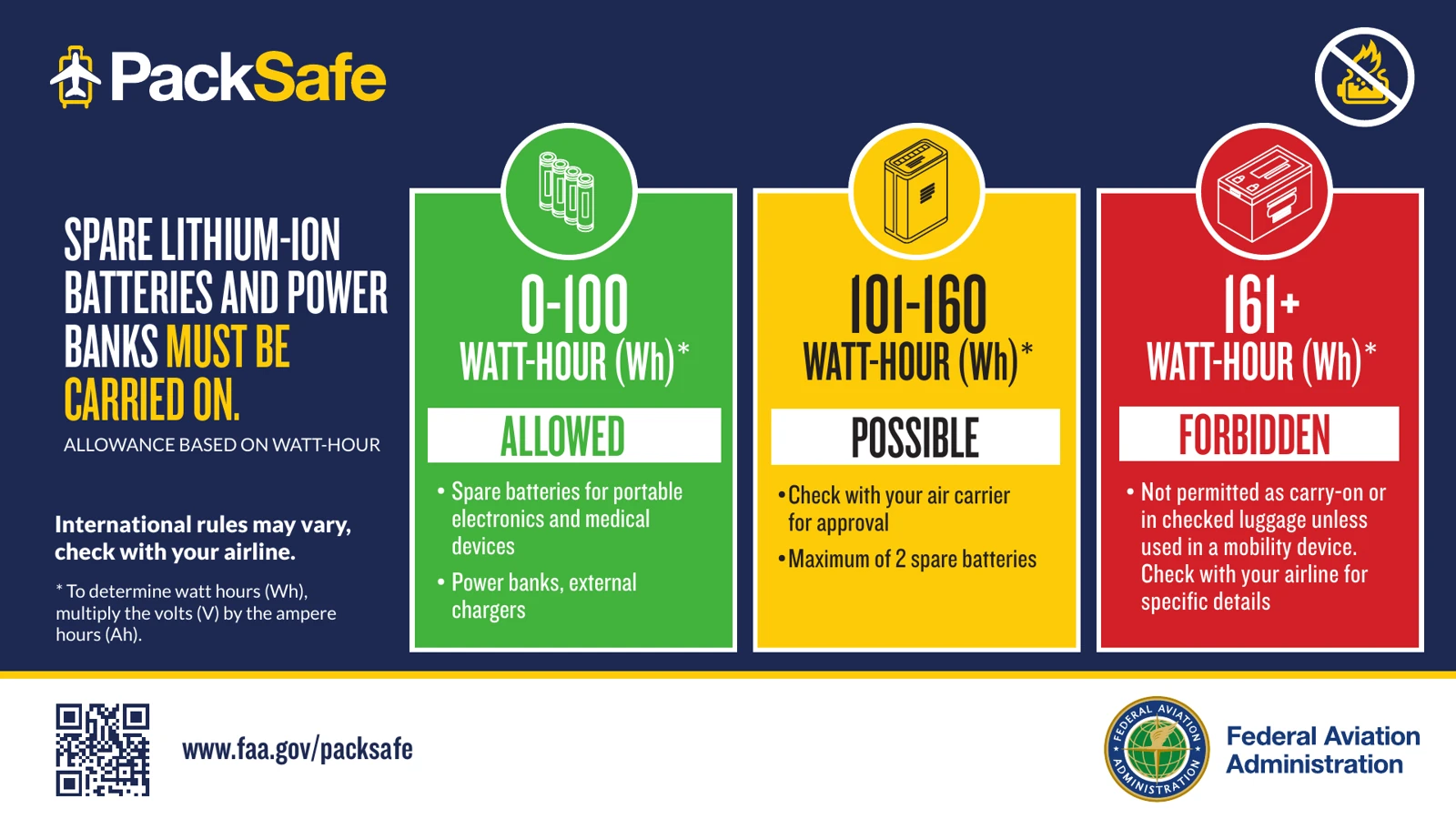
The FAA’s battery guidance, updated October 2, 2026, says spare lithium batteries, power banks and portable chargers cannot go in checked baggage. If your carry-on is checked at the gate, take those items out and keep them in the cabin. Protect terminals from contact with metal and protect batteries from damage.
For ordinary rechargeable batteries, the usual limit is 100 watt-hours per battery. Batteries above 100 and up to 160 watt-hours require airline approval; no more than two spare batteries in that larger category are allowed per passenger. Larger ordinary power banks are prohibited. Mobility-aid batteries have separate provisions, so arrange those directly with the airline.
There is no single FAA two-power-bank limit covering every small battery: the FAA says airlines may impose tighter quantity and capacity restrictions. Read your own carrier’s policy, including any rules on use or charging during flight.
Electronic cigarettes and vaping devices must also stay out of checked baggage. Prevent accidental activation; the FAA prohibits recharging those devices and batteries aboard the aircraft. Damaged or recalled batteries that could spark or produce dangerous heat are not suitable for flight unless made safe under the applicable rules. Alert the crew immediately if a device overheats, swells, smokes or burns.
About the airport setting: three sets of rules meet here
These requirements concern U.S. airport screening and passenger-aircraft safety, rather than a single vacation destination. REAL ID addresses the security standards for state-issued identity documents. Checkpoint procedures address people and belongings entering the secure area, while hazardous-material rules address what can travel safely aboard the aircraft.
Airport layouts and services differ. The Port of Seattle, for example, lists several screening types at Seattle–Tacoma International Airport, while the Metropolitan Washington Airports Authority describes separate checkpoints and services at Reagan National in Arlington, Virginia. Their operational guidance is useful for those airports, but a local lane or service is not a nationwide entitlement.
Airline cabin-bag size, weight, item-count and ticket-related charges are another layer. Passing TSA screening does not establish that your fare includes an overhead-bin bag. Check the airline and each departure airport, including the return journey.
What Travelers Need to Know
Before leaving home: choose an accepted physical ID, confirm any international travel documents, and use ConfirmID only if you need the alternative process. Leave additional time if identity verification or special screening is likely.
Before closing the bag: check toiletry container capacities, separate any medical or child-nourishment items needing review, and keep spare batteries and power banks accessible. Start with a bag you have checked for prohibited items, including forgotten items in side pockets.
Before boarding: confirm the airline’s baggage and battery policies. If staff take your cabin bag for checking, remove power banks and spare lithium batteries first. Use the linked official TSA item lookup for a particular object instead of treating this overview as permission to carry it.
Related coverage and timeline · Report an error
Sources
USAGov: REAL ID and accepted alternatives
TSA ConfirmID: official payment form and conditions
TSA December 1, 2025 announcement, reproduced by Springfield Airport Authority January 27, 2026
Port of Seattle: identification and documentation requirements
Port of Seattle: TSA prohibited items and liquids guidance
DHS official July 8, 2025 shoes-on announcement photo and caption
Metropolitan Washington Airports Authority: Reagan National security information
FAA: airline passengers and batteries
FAA: lithium batteries and gate-check precautions
FAA: electronic cigarettes and vaping devices
Heathrow: January 23, 2026 scanner announcement